

The Governance Office helps make sure student appeals are handled fairly, consistently, and according to University rules, policies, and regulations. The Governance Office is a neutral team that guides the process that ensures everyone is treated respectfully and decisions are made in a clear and transparent way.
Appeals at a Glance
The Governance Office oversees student Appeals in Academic Matters and Academic Misconduct Appeals. While both appeals processes are guided by their distinct Procedures and have their own respective intake forms, the appeals process with the Governance Office is the same.
- Most appeals are completed within 3–4 months
- Hearings are held virtually
- Students may bring a support person and/or an advocate
- Decisions are provided within 15 business days of the Appeal Board reaching a decision
Can I Appeal?
A university-level appeal must:
- • Be based on recognized appeal grounds (found in the related Procedures)
• Follow completion of the college-level process
• Must be submitted within 30 business days
Before You Begin
Before submitting a university-level appeal, you must first complete the process or appeal proceeding available through the college or school related to the course or decision.
University-level appeals must be submitted within 30 business days of receiving your final college-level decision in writing.
Understanding the Student Appeal Process
1. Submitting an Appeal
Students must complete the college-level process and/or appeal before progressing to a university-level appeal at the Governance Office.
Every university-level appeal begins with a formal submission based on established grounds for appeal. These grounds are fixed and defined, and found in the respective Procedures. Appeals must clearly align with the respective ground(s) of appeal in order to proceed.
To submit an appeal, you will need:
- A completed appeal intake form
- A written statement explaining:
- The decision being appealed
- The applicable appeal ground(s)
- How the ground(s) apply
- The outcome you are requesting
- Supporting documentation or evidence
Once submitted, the Governance Office reviews the appeal and the associated college file to determine if it has sufficient merit to move forward. This initial decision is typically made within 30 business days.
If an appeal does not meet the criteria, it will be dismissed without a hearing. This decision is final within the University, with no additional internal appeal options.
2. Early Review and Next Steps
If an appeal proceeds, the student becomes the Appellant and the college or school becomes the Respondent. The Respondent is then given an opportunity – typically about three weeks – to provide a response.
From here, the process shifts toward preparing for a formal hearing.
Because each case is unique, timelines may vary, but most appeals take approximately 3–4 months from submission to final outcome. Factors like case complexity, time of year, and scheduling availability can influence this timeline.
3. Preparing for the Hearing
Once the appeal moves forward, an Appeal Board is established. This board includes:
- Two faculty members of University Council (one serves as Chair)
- One student member of University Council
Appeal Board members are intentionally chosen without direct ties to the program or college involved to ensure impartiality. The Governance Office has potential appeal board members confirm they do not have a conflict of interest with the parties before proceeding and having them serve on that particular Appeal Board.
Scheduling a hearing requires coordinating multiple calendars. While your availability is considered, the final date is determined based on overall feasibility. Hearings are typically held at either 9:00 AM or 1:00 PM via Zoom.
4. Support and Representation
You don’t have to go through the process alone.
Appellants and Respondents can both choose to bring a support person and/or an advocate.
You may bring a support person—someone who can help you prepare and provide emotional support during the hearing. Support persons generally do not speak on your behalf.
You may also bring an advocate as well or instead, who can present your case or respond on your behalf. However, you may still be asked to answer questions directly.
Most students do not use legal representation during the appeal process. However, you may seek legal advice or choose to have a lawyer act as your advocate.
While the Governance Office does not provide advocates and does not serve as a support person or advocate, students can often access support through their student union (USSU), the GSA, the Gordon Oakes Red Bear Student Centre, and/or Student Affairs and Outreach.
If you require accommodations, you are encouraged to request them early so arrangements can be made in advance.
5. What Happens at the Hearing
Appeal hearings follow a structured and respectful format. Each party has the opportunity to present their case, ask questions, and make closing statements.
A typical hearing includes:
- Opening statements from both parties
- Presentation of the Appellant’s case
- Questions from the Appeal Board and the other party
- Presentation of the Respondent’s case
- Questions from the Appeal Board and the other party
- Closing statements from both parties
Hearings are formal but designed to be fair and accessible. The Governance Office offers pre-hearing meetings to help you understand the process and feel prepared.
It’s important to stay focused on the relevant appeal grounds—questions and discussions must directly relate to the matter under review. The Chair of the Appeal Board and/or the other party can flag a line of questioning as outside the scope of the appeal and decide it will not be answered.
6. Deliberation and Decision
After the hearing concludes, the Appeal Board meets privately (in-camera) to deliberate. In some cases, additional meetings may be needed before reaching a decision. The Appeal Board is not required to come to a decision the same day as the appeal hearing.
Once a decision is finalized, a written report is prepared and shared with the parties within 15 business days of the Appeal Board coming to a decision (not 15 business days from the date of the hearing).
Decisions are comprehensive and carefully developed to reflect the complexity of each case.
7. After the Appeal
The outcome of your appeal will either uphold, alter or overturn the original decision. While outcomes are considered private, they are not strictly confidential.
Appeal decisions within the University are final—there are no further internal avenues for appeal.
Appeal Board decisions are final. Parties should not contact Appeal Board members directly regarding a decision after receiving the report.
8. Additional Considerations
- Virtual access: Hearings are conducted online, so you can participate from anywhere.
- Witnesses: Parties cannot bring witnesses; however, the Appeal Board may call them in rare cases.
- Confidentiality: The process is handled with care to protect privacy and fairness.
- Timing: Delays can occur due to scheduling, complexity, or high case volumes—flexibility is key.
A Supportive, Fair Process
While the appeals process is formal and thorough, it is designed with fairness, transparency, and student support in mind. Understanding each step can help you feel more confident and prepared as your appeal progresses.
Appeals By Numbers
May 1, 2025 – April 20, 2026
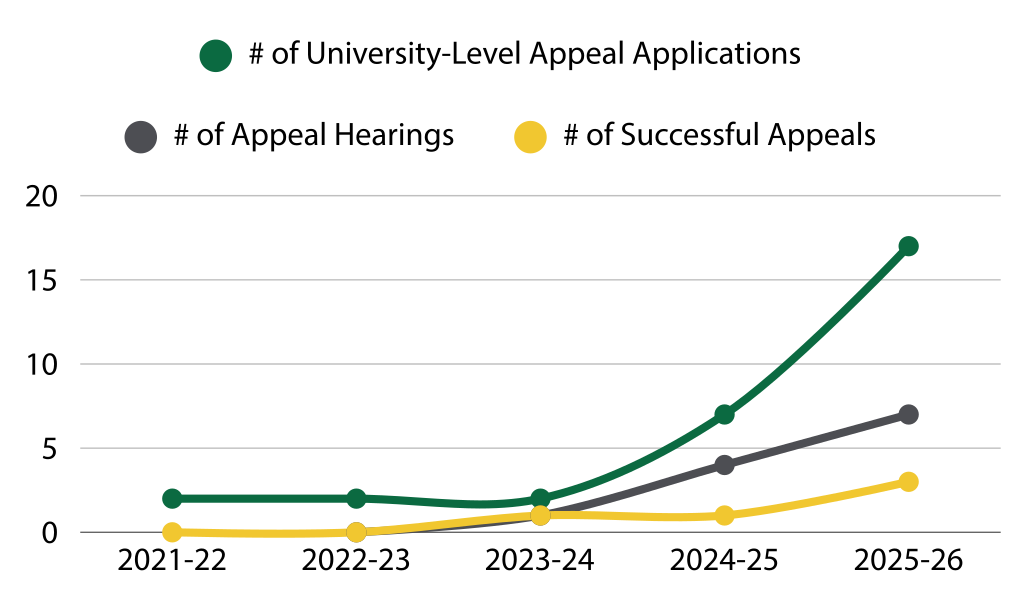
7 |
4 |
1 |
| Academic appeal applications | Academic appeal hearings | Successful appeals in academic matters at hearing |
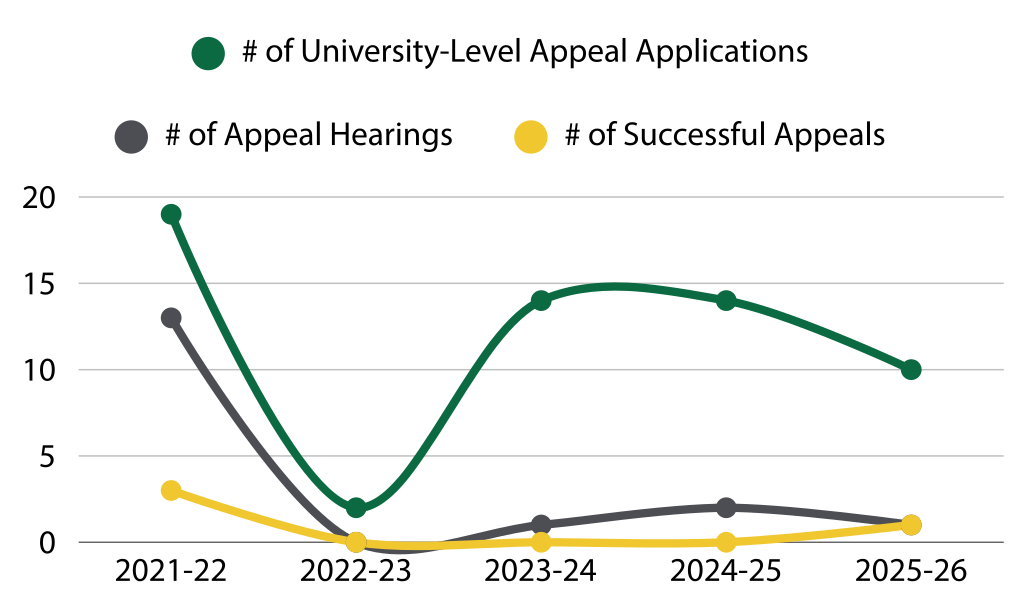
14 |
2 |
0 |
| Academic misconduct appeal applications |
Academic misconduct appeal hearings |
Successful academic misconduct appeals at hearing |
Academic Misconduct
* 1 was withdrawn in 2025-26
Under Council’s regulations on student misconduct, allegations of academic misconduct are heard first at the college level. In a small number of cases, including at least two this year, matters were redirected back to the appropriate college-level process where the university-level appeal process was not yet appropriate.
Appeals in Academic Matters
* 1 was withdrawn in 2025-26
Appeals are becoming increasingly complex, often involving multiple layers of concerns and challenges between the parties. There has also been an increase in appeals involving allegations that accommodation policies were not properly followed, as well as allegations or concerns relating to discrimination.
Since September 2025 - June 2026, the Governance Office received approximately 73 inquiries relating to student conduct and appeals.
Contact
The Governance Office is available to answer questions about appeal procedures, timelines, and process requirements. While the Governance Office does not provide advice or advocacy, the Office is happy to help students understand the process and know what to expect
Governance Appeals
governance.appeals@usask.ca